Daniel Defoe (1660-1731) has become a media darling recently. And it’s not for writing Robinson Crusoe, the first English novel, at age 59.
It’s for creating the first work of “faction,” that strange hybrid of fact and fiction, titled A Journal of the Plague Year. His uncanny parallels to our 2020 coronavirus crisis, written three hundred years ago, have made for a curious bestseller.
According to The Telegraph, several of London’s most popular independent bookshops, including John Sandoe Books, have run out of copies.
A Journal of the Plague Year purports to be an eyewitness account of London’s Great Plague of 1665. Its author is HF, a London saddler who shelters in place during the epidemic. Here are some of his observations:
The infection started in the East, possibly in China. It devastated Italy before it hit England’s stores. At first, no one in London paid attention.
But it seems that the Government had a true account of it, and several councils were held about ways to prevent its coming over; but all was kept very private.”
Nothing was done until it was too late. “And from the first week of June the infection spread in a dreadful manner.” Panic set in. Many Londoners fled the city.
Others raided the markets, “laid up stores of provisions sufficient for their whole families, and shut themselves up.” Still others ignored the warnings and went about their business. So the thing spread.
The government finally stepped in and prohibited “public feasting…dinners at taverns, ale-houses, and other places of common entertainment.” Strict quarantine rules were enforced.
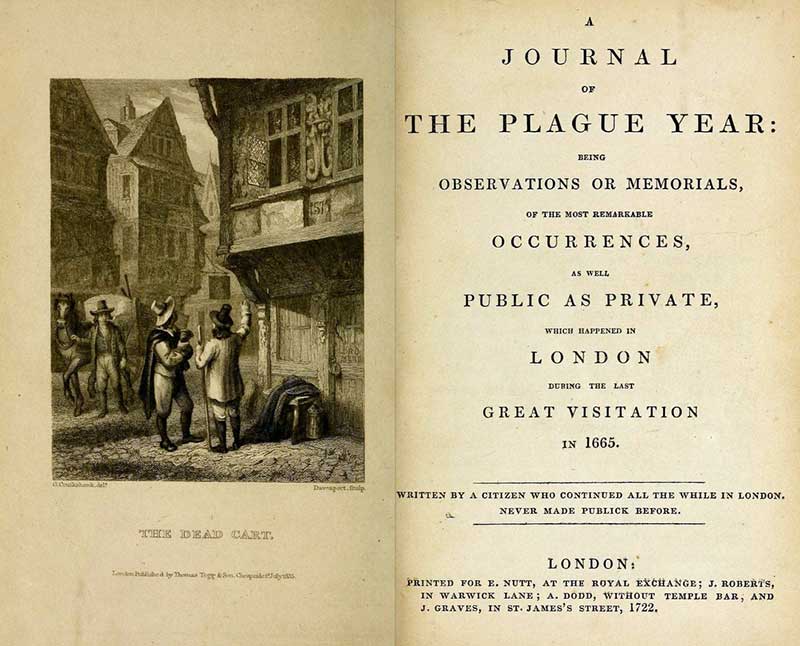
Within a year, the plague ran its course. In 1666, a baker accidentally burned a quarter of London to the ground. Some historians believe the fire drove out the rats that sheltered the fleas that carried the disease. At least 68,596 Londoners died from the plague and many more from the fire.
So tragic, yet so familiar. The London we see today comes from a herculean rebuilding effort.
But that’s not the twist. Daniel Defoe published A Journal of the Plague at age 62. The plague ended Defoe was six. So it’s certainly not “eye witness.”
Defoe himself called it fiction. But he used the memories of his uncle Henry Foe, a saddler, combined with mortality bills, oral testimonies, and official proclamations to create the first work of “faction.”
Just who was Daniel Defoe, late-blooming author of both the first English novel and first work of narrative nonfiction?
The Failed Venture Capitalist
Daniel was born to James and Annie Foe in 1660 (perhaps September 13), long before England embraced religious tolerance. His parents were Presbyterian, a persecuted group of “Dissenters” from the Church of England.
Oxford and Cambridge barred Daniel Foe because of his religion. He attended a Dissenting college to please his father, who wanted him to become a minister.
But the minister’s life didn’t appeal to Daniel, though he remained committed to religious freedom. Instead, he became a venture capitalist with more imagination than skill.
He raised funds to search for sunken treasure via a diving bell. The venture tanked.
He bred African civets, collecting and selling the animals’ musky secretions for perfume manufacture. That proved messy.

At age 24, Daniel wed a London merchant’s daughter. She brought him a £3,700 dowry (about a half-million today). He set up a wine and wool import/export company with those funds, which might have thrived if a civil war hadn’t intervened.
In 1685, Daniel joined a revolt against James II, England’s unpopular Catholic monarch. The rebellion failed, and Daniel somehow escaped a traitor’s death.
One legend says that, after a fatal battle, he fled into a churchyard. Scared witless, praying for deliverance, he collapsed upon a grave. On its tombstone was carved the name “Robinson Crusoe.”
Three years later, the Protestant William of Holland invaded England. James II fled to France, effectively abdicating. Daniel supported, and perhaps even spied for, King William. But William embargoed trade with France, which ruined the last of Daniel’s ventures.
He was arrested for debts close to £17,000 and declared bankruptcy. His civets were seized. Daniel eventually gave up venture capitalism and turned to propaganda.
Before Daniel Became Defoe: The Turncoat Pamphleteer
In 1702, Daniel wrote a tract titled The Shortest-Way with the Dissenters, a satirical piece that argued for their extermination, presaging Jonathan Swift’s A Modest Proposal. He targeted the religious intolerance of high-church Tories.
For this, Daniel was fined, pilloried, and jailed for over a year. It deeply affected him:
I have seen the rough side of the World as well as the smooth, and have in less than half a Year tasted the difference between the Closet of a King, and the Dungeon of Newgate.
A Tory spymaster finally offered Daniel freedom—if he’d spy for his jailers. So began his career as a turncoat, and his regular use of the surname Defoe.
(Supposedly, he thought Defoe sounded more “gentlemanly.” But perhaps he saw the irony of a turncoat named Foe.)
After the Tories fell, Daniel Defoe became a propagandist for the Whig government. His biographers seem at a loss to explain his turncoat politics, but this 1907 essay provides the most compelling vindication:
His position was often equivocal, his actions ambiguous; but on the whole he worked consistently for the promotion of civil and religious liberty, the cause in which he believed…
For Defoe, ever the religious Dissenter, both political parties were equally oppressive.
Daniel Defoe: The Late-Blooming Author
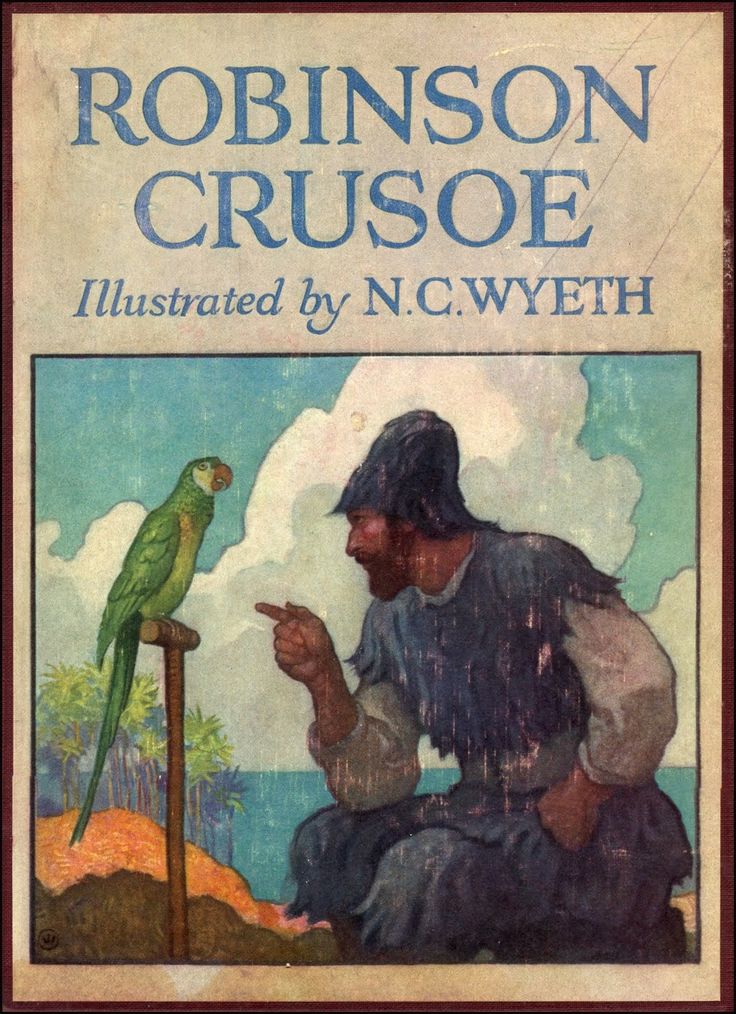
As he neared 60, Defoe wearied of sleazy politics. He turned his pen to fiction with a tale titled The Life and Strange Surprizing Adventures of Robinson Crusoe.
There’s no need for a synopsis. Almost every child has devoured it, except, perhaps, Jenni Diski of The Guardian. “As soon as I was able to read by myself, I tried and failed to finish it,” she admits.
But she tried again five decades later and found herself enthralled:
I suspect that what I most disliked then was the dogged, repetitive, unrelenting detail of Crusoe’s struggle for existence, which is now precisely what I find myself relishing, so much so that when I finished Defoe’s intensely readable book last year, I immediately started all over again.
Perhaps that’s because Defoe never considered Robinson Crusoe a children’s book. His life had been dogged by misfortune, his imagination shackled by stress. Maybe it was a book borne of adult travail and hope of rescue.
At the age of 62, Defoe published Moll Flanders, Colonel Jack, and A Journal of the Plague Year. His last great work of fiction, Roxana, came out a few years later.
After that, Defoe returned to nonfiction—the satirical Political History of the Devil, the intriguing Essay on the History and Reality of Apparitions, and the captivating Tour Through the Whole Island of Great Britain, among others.
What Makes Daniel Defoe a Compelling Later Bloomer?
In The Wall Street Journal, Danny Heitman pinpoints Robinson Crusoe‘s most profound message—the “affirmation of literature itself.”
The centerpiece of the novel is the journal that Crusoe keeps during his exile, an attempt to shape the confusion of castaway existence into a coherent story.…His pen, as much as his ax or his musket, becomes a tool of survival.
The same could be said of Defoe, who gave us two pioneering works of literature—Robinson Crusoe at age 59, a contender for the first novel, and A Journal of the Plague Year at age 62, the first work of narrative nonfiction.
Defoe passed away at age 71. In 1857, his headstone was struck by lightning. Seventeen years later, a London newspaper called for donations to replace it with a memorial. More than 1700 people, mostly children, contributed to the five-foot marble obelisk that marks his resting place today.
How fitting that Daniel Defoe’s unconventional, late-blooming spirit prompted the first literary crowdfunding campaign.
Sources
The University of Adelaide has some gorgeously-formatted downloads of public domain books and essays, including Defoe’s, in HTML, ePub, and Kindle formats. Don’t miss Robinson Crusoe with N.C. Wyeth’s illustrations and The Storm.
The Telegraph. “Daniel Defoe’s Journal of the Plague Year being reprinted after selling out.” 21 March 2020.
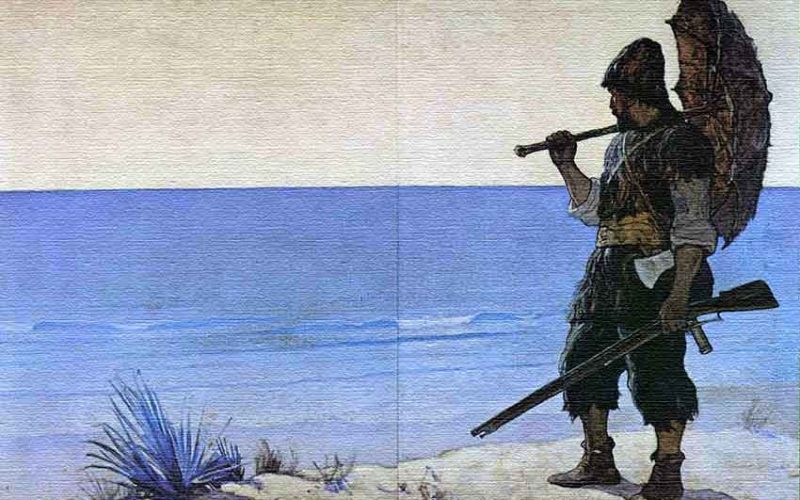
Artwork: Robinson Crusoe (endpaper) by N.C. Wyeth (1910).